
Replace the Spreadsheet Running Your Business
Most companies have one file everything depends on and nobody fully trusts. A web application turns that into a system with permissions, history, validation and reporting.
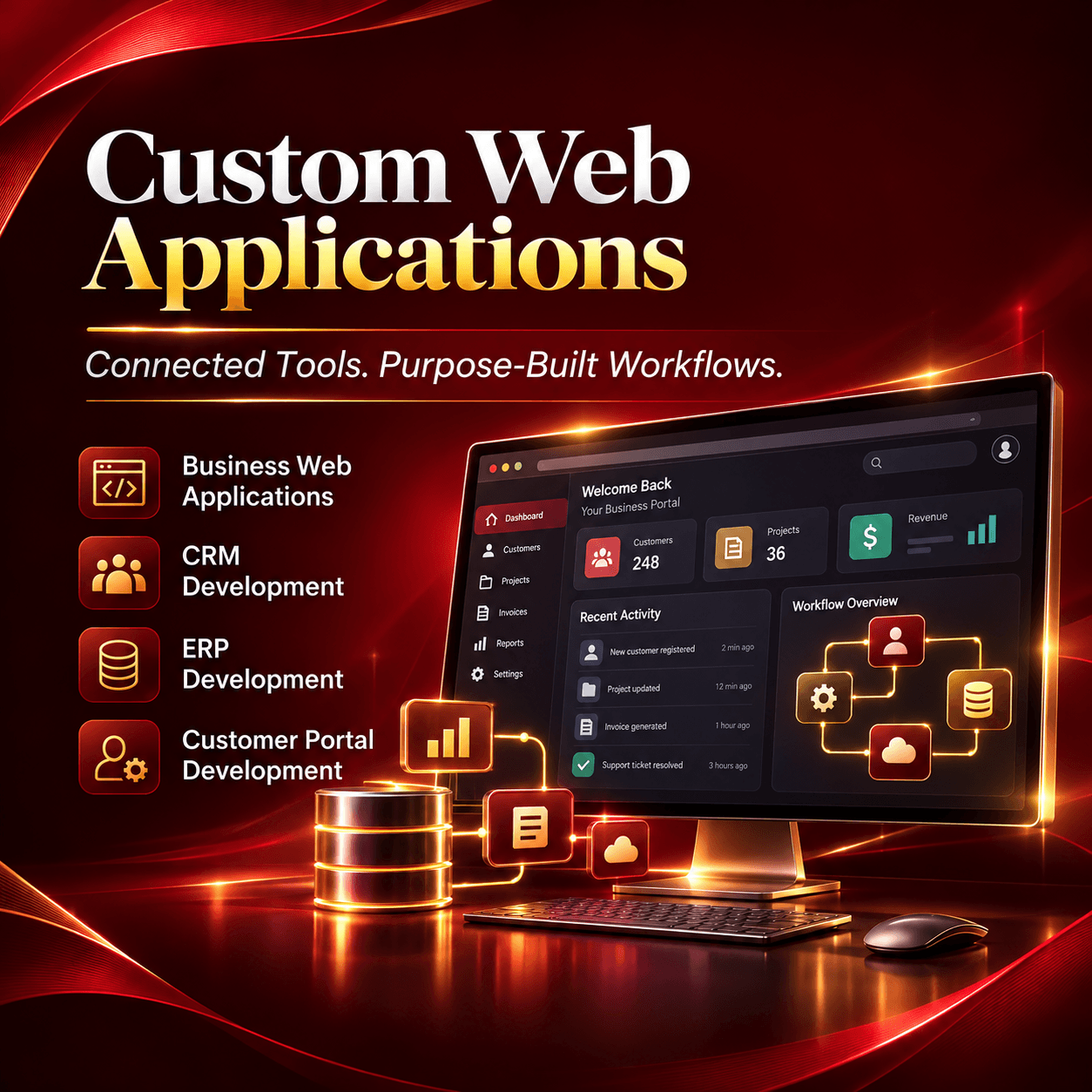
What's included
- Business Web Applications
- CRM Development
- ERP Development
- Customer Portal Development
- Admin Dashboard Development
- Workflow Automation
- API Integration
- Web Application Support
What Is a Web Application?
A web application is software that runs in the browser — no installation, instantly updatable, accessible from any device with a login.
That delivery model is why internal tools have largely moved to the web. One deployment updates every user, access is controlled centrally, and the same interface works on a laptop, a tablet in a warehouse, or a phone in the field.
Web applications typically sit between systems: pulling from a CRM, writing to an ERP, exposing a portal to customers, and enforcing the rules that connect them.
Why Businesses Build Web Apps
Shared spreadsheets have no permissions, no validation and no audit trail. As a team grows, that becomes a genuine operational risk.
Manual reporting is the other symptom — someone spending a day each month assembling numbers that a system could produce continuously.
A web application replaces both, and gives customers or partners a self-service view instead of an email thread.
Businesses invest in web apps to:
- Replace shared spreadsheets
- Control access by role
- Automate recurring reporting
- Give customers self-service
- Connect existing systems
- Keep an auditable history
- Work from anywhere securely
- Scale as the team grows
Our web application services
Internal tools and customer-facing platforms built on modern, maintainable stacks.
- 01
Business Web Applications
Operational tools built around your specific workflow and rules.
- 02
CRM Development
Custom pipeline and relationship systems where packaged CRMs do not fit.
- 03
ERP Development
Modular resource planning applications built department by department.
- 04
Customer Portal Development
Self-service portals for orders, documents, tickets and account data.
- 05
Admin Dashboard Development
Role-based dashboards that surface the numbers people actually act on.
- 06
Workflow Automation
Approvals, notifications and handoffs handled by the system rather than email.
- 07
API Integration
Third-party services connected reliably with proper error and retry handling.
- 08
Application Support
Monitoring, enhancement and maintenance under an agreed service level.
Benefits of a real system
Access anywhere
Browser-based, on any device, instantly updated.
Controlled permissions
People see only what their role allows.
Validated data
Errors caught at entry rather than at reporting.
Live reporting
Numbers available continuously, not monthly.
Full audit trail
Every change recorded and attributable.
Why many projects go wrong
Most failed builds fail on process rather than technology — unclear scope, no testing, and no plan for what happens after launch.
- Scope agreed only in conversation
- Design signed off without prototypes
- No staging or review environment
- Performance ignored until launch
- Content arriving after the build
- No accessibility consideration
- Nobody owning post-launch support
- Code with no documentation
A clear path from brief to launch
Discovery & requirements
We map users, goals, constraints and what success looks like in numbers.
Information architecture
Structure, navigation and content model agreed before any visual design.
Wireframes & prototypes
Interactive flows reviewed and signed off while changes are still cheap.
Visual design
Interface design, components and a design system your brand can grow into.
Development
Built in reviewable increments with version control, code review and staging.
Testing & QA
Functional, cross-browser, device, performance and accessibility testing.
Launch
Deployment, DNS, analytics, tracking and search console configured properly.
Support & iteration
Monitoring, updates and improvements on an agreed ongoing cycle.
Results measured in performance, not page count
- Core Web Vitals
- Conversion Rate
- Mobile Usability
- Uptime & Stability
- Search Crawlability
- Support Response Time
Web application pricing
Phased delivery so the first useful module ships early.
Custom
On request
enterprise scope
- As per need modules
- As per need user roles
- As per need API integrations
Pricing varies with scope, integrations and content volume — every project is quoted after a discovery call.
The right build partner changes the outcome
Scoped honestly
You know cost and timeline before work starts.
Built to standards
Clean, documented, maintainable code.
Performance first
Speed budgets agreed and enforced.
Full ownership
Code and accounts stay yours.
Supported after launch
We stay responsible for what we ship.

FAQ
Let's Clear Your
Doubts
A marketing site of eight to twelve pages usually runs six to ten weeks from kickoff to launch. E-commerce and custom applications are longer. The single biggest variable is content readiness, which is why we agree a content plan during discovery.
Fixed price for defined scopes, so you know cost and timeline before work starts. Ongoing work after launch runs on a retainer. If scope changes mid-project we quote the change rather than absorbing it silently and slipping the date.
Yes. We build on a CMS with a content model designed for your editors, and hand over with training. Routine changes should never require a developer, and if they do we have built it wrong.
You do. Code lives in a repository in your name, hosting and domains are registered to you, and everything is handed over documented at launch. There is no lock-in.
Yes — structure, markup, speed, crawl paths and structured data are part of the build, not a later add-on. Retrofitting technical SEO onto a finished site costs far more than doing it correctly the first time.
Thirty days of post-launch support is included on every build, covering anything that is not working as specified. After that most clients move to a care plan for updates, backups, monitoring and ongoing improvements.